VOO Has Made Millionaires, But Its 1.1% Yield Worries Retirees

Photo of David Beren
By David Beren Published

Quick Read

  • Vanguard S&P 500 ETF (VOO) holds $1.5T in assets. VOO gained 17.69% over the past year.

  • NVIDIA, Apple and Microsoft account for 19.7% of VOO as technology concentration reaches 33.1%.

  • VOO’s 1.1% dividend yield trails both the 10-year Treasury at 4.03% and the 2.2% inflation rate.

  • Are you ahead, or behind on retirement? SmartAsset's free tool can match you with a financial advisor in minutes to help you answer that today. Each advisor has been carefully vetted, and must act in your best interests. Don't waste another minute; learn more here.(Sponsor)
This post may contain links from our sponsors and affiliates, and Flywheel Publishing may receive compensation for actions taken through them.
VOO Has Made Millionaires, But Its 1.1% Yield Worries Retirees

© Ja Crispy / Shutterstock.com

Even if you are a stock market newbie, there is a better than good chance you know that VOO sits at the center of nearly every personal finance conversation online, not because it is flashy, but because it works. Vanguard S&P 500 ETF (NYSEARCA:VOO) has become the default answer to almost any investing question, from a 25-year-old wondering what to do with a windfall to someone debating whether to pay off their mortgage. The sentiment score on Reddit has held steady at roughly 59 to 60 across the past week, month, and quarter, which tells its own story: nobody is panicking, and nobody is euphoric. VOO is just there, quietly doing its job.

The fund currently trades at $636, up 15% over the past year and 76% over five years, which is pretty incredible for a fund with $1.5 trillion in net assets and an expense ratio of just 0.03%, it is one of the most cost-efficient ways to own a broad slice of the U.S. economy.

The $100K Milestone Is Driving the Conversation

The most engaging VOO thread of the past month asked a simple question: “Is it true once you hit 100k in investing, it really just takes off from there?” It pulled 3,404 upvotes and 1,371 comments on r/investing, with VOO cited repeatedly as the core holding behind that compounding effect. The discussion reflects how Reddit investors actually think about VOO: not as an income vehicle, but as the engine of long-term wealth accumulation.
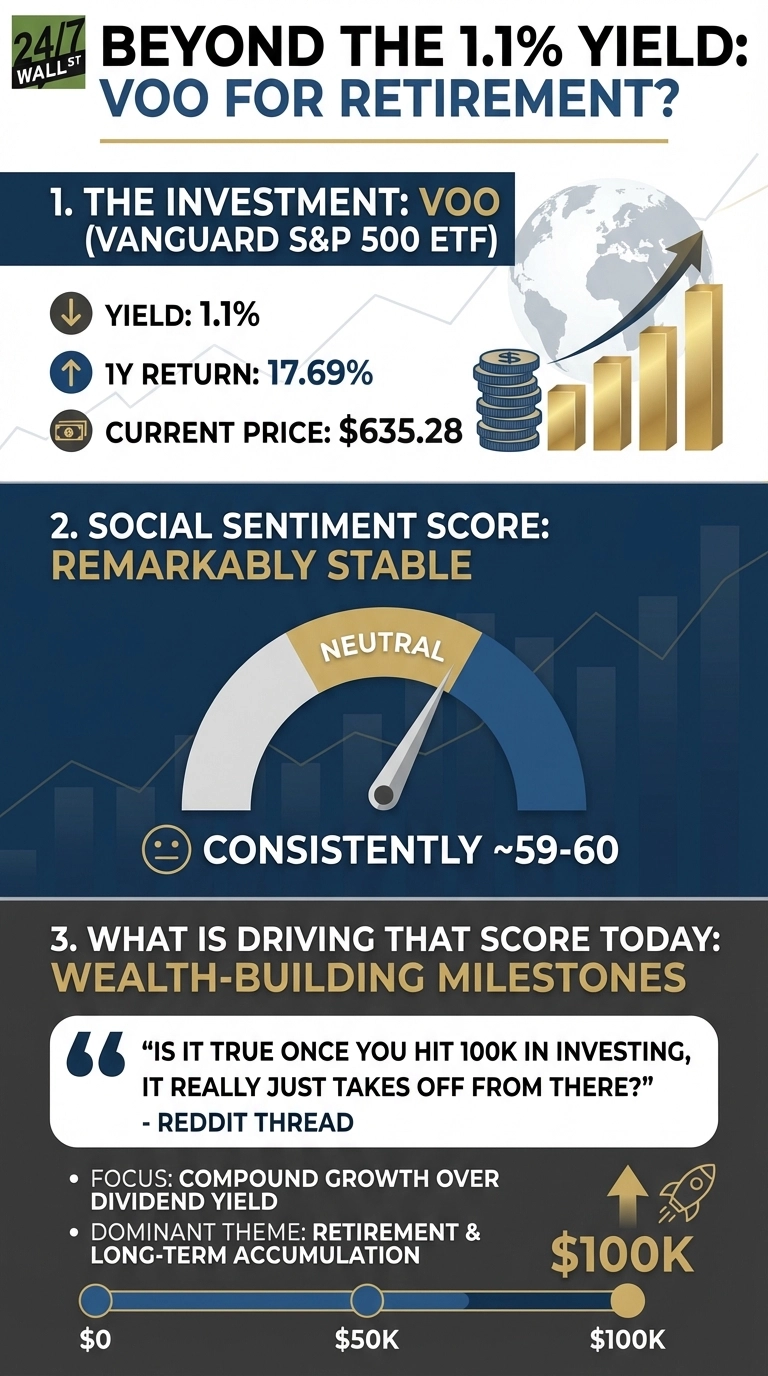
An infographic titled 'Beyond the 1.1% Yield: VOO for Retirement?' divided into three sections. Section 1, 'The Investment: VOO (Vanguard S&P 500 ETF)', shows a yield of 1.1%, 1-year return of 17.69%, and current price of $635.28, accompanied by a globe and financial growth icons. Section 2, 'Social Sentiment Score: Remarkably Stable', features a gauge indicating a 'Neutral' sentiment consistently around 59-60. Section 3, 'What is driving that score today: Wealth-Building Milestones', includes a Reddit quote about hitting $100K in investing, and lists 'Compound growth over dividend yield' and 'Retirement & long-term accumulation' as key themes. A progress bar visualizes the journey from $0 to $100K, marked with a rocket icon at the $100K milestone.
24/7 Wall St.
This infographic details the Vanguard S&P 500 ETF (VOO)’s performance metrics and analyzes its remarkably stable social sentiment, driven by discussions around wealth-building milestones for retirement.
Is it true once you hit 100k in investing, it really just takes off from there?
by u/[OP] in investing
“Is it true once you hit 100k in investing, it really just takes off from there? I keep hearing this and want to know if it’s actually true or just a motivational thing people say.” — u/[OP], r/investing


VOO’s 1.1% Yield Is a Feature, Not a Bug

Ultimately, the yield question matters more as investors ask whether VOO’s 1.1% dividend yield has merit, knowing that it sits well below the current 10-year Treasury yield of 4.03% and even below the 2.2% inflation rate, meaning dividend income alone does not keep pace with rising prices. The portfolio is also heavily weighted toward technology at 34.1%, with the top three holdings, NVIDIA, Apple, and Microsoft, accounting for roughly 19.7% of the fund alone. That concentration drives the growth story but compresses the yield.

For younger investors, that trade-off is clearly acceptable. The debate worth watching is whether that calculus holds for investors within a decade of retirement, where income and sequence-of-returns risk start to matter more than raw appreciation.


 
Photo of David Beren
About the Author David Beren →

David Beren has been a Flywheel Publishing contributor since 2022. Writing for 24/7 Wall St. since 2023, David loves to write about topics of all shapes and sizes. As a technology expert, David focuses heavily on consumer electronics brands, automobiles, and general technology. He has previously written for LifeWire, formerly About.com.

As a part-time freelance writer, David’s “day job” has been working on and leading social media for multiple Fortune 100 brands. David loves the flexibility of this field and its ability to reach customers exactly where they like to spend their time. Additionally, David previously published his own blog, TmoNews.com, which reached 3 million readers in its first year.

In addition to freelance and social media work, David loves to spend time with his family and children and relive the glory days of video game consoles by playing any retro game console he can get his hands on.

Featured Reads

Our top personal finance-related articles today. Your wallet will thank you later.

Continue Reading

Top Gaining Stocks

APA
APA Vol: 23,883,496
+$1.05
+2.76%
$39.11
Aon
AON Vol: 2,408,528
+$8.64
+2.73%
$325.63
TTD Vol: 24,213,212
+$0.60
+2.55%
$24.11
AJG Vol: 3,845,140
+$5.14
+2.45%
$214.82
PSKY Vol: 23,894,119
+$0.19
+2.12%
$9.15

Top Losing Stocks

SMCI Vol: 243,039,023
-$10.26
33.32%
$20.53
VST Vol: 11,108,700
-$21.35
12.76%
$146.02
CEG Vol: 6,237,209
-$34.48
10.90%
$281.99
MOS Vol: 21,771,381
-$2.61
9.96%
$23.59
NRG Vol: 4,160,964
-$15.60
9.67%
$145.80